How to case an NH35 movement
Casing is where the movement, with its dial and hands already fitted, goes into the watch case. On a Seiko NH35 (and the day-date NH36) you take the stem out, fit the movement ring, lower the movement into the case dial-first, and push the stem back in through the case until it clicks. Most first-time builders also have to shorten the stem, because the stems sold with movements are longer than any case needs. The stem release is a tiny push point next to the stem on the back of the movement. It needs only a light press, with the crown pushed fully in. Cut the stem a little at a time, always off the watch. You can take more off later, but you can't put it back.
- Time
- 30–60 minFor your first watch. Most of it goes on getting the stem length right.
- Difficulty
- ModerateTaking the stem out is easy once you've found the release. Measuring and cutting the stem takes patience.
- Works with
- NH35
- NH36
What you need
Parts
NH35 or NH36 movement
With the dial and hands fitted (see the dial and hands guides).
The watch case and its crown
With its crystal fitted, and the crown that came with it.
The movement ring (spacer)
The one that came with the case, if it has one.
The winding stem
The long stem supplied with the movement, or one sold for your case. Check the listing says "NH35" (or NH35/NH36). Stems for other movements look similar but won't lock in.
Tools
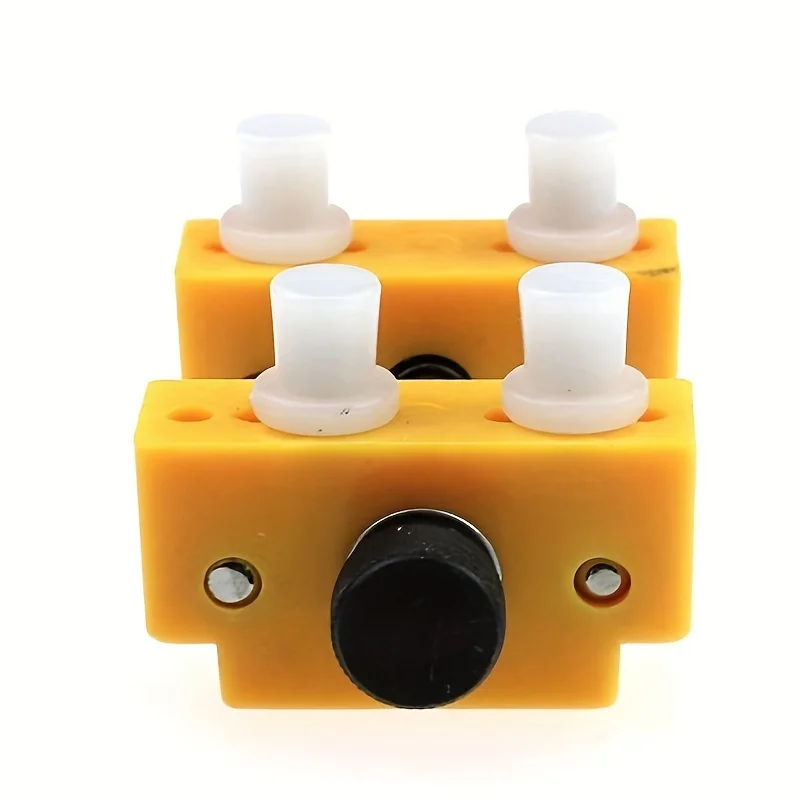
- Case holder
- Movement holder
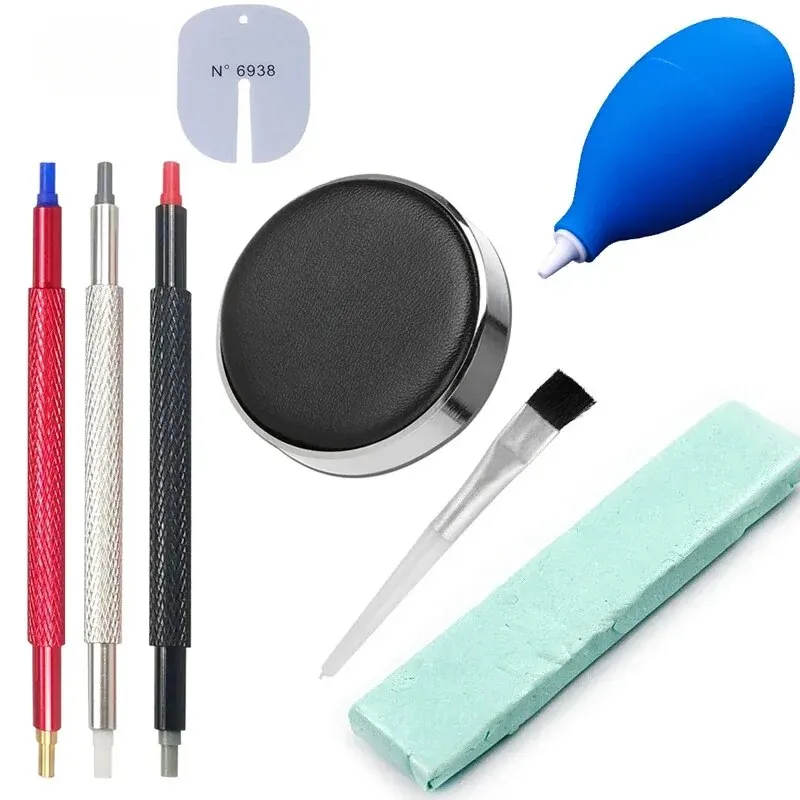
- Fine plastic- or brass-tipped tweezers, or a fine screwdriver
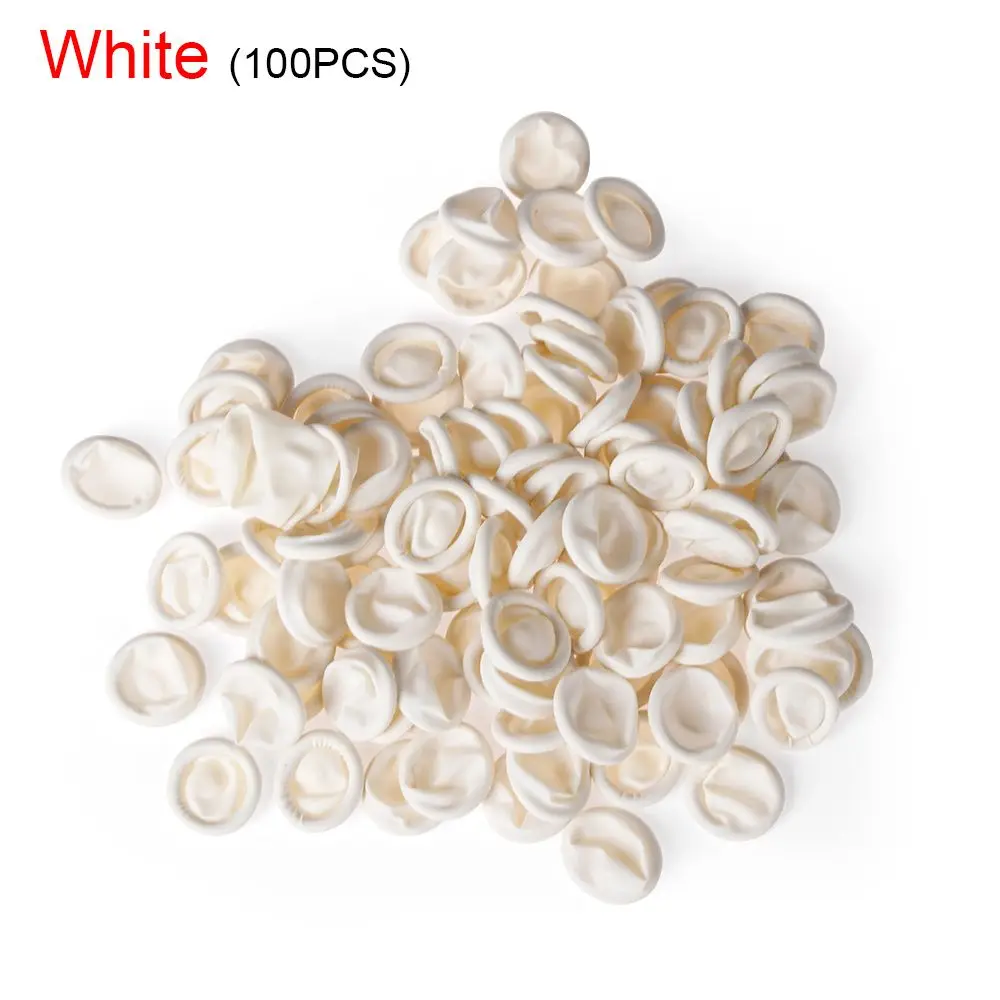
- Nitrile gloves or finger cots
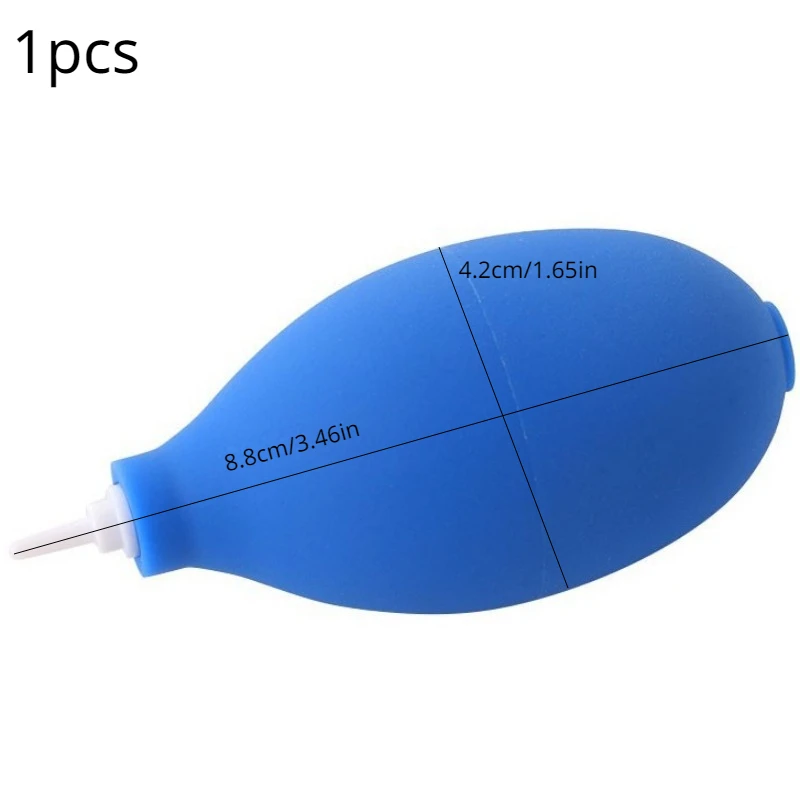
- Hand air blower (rubber bulb)
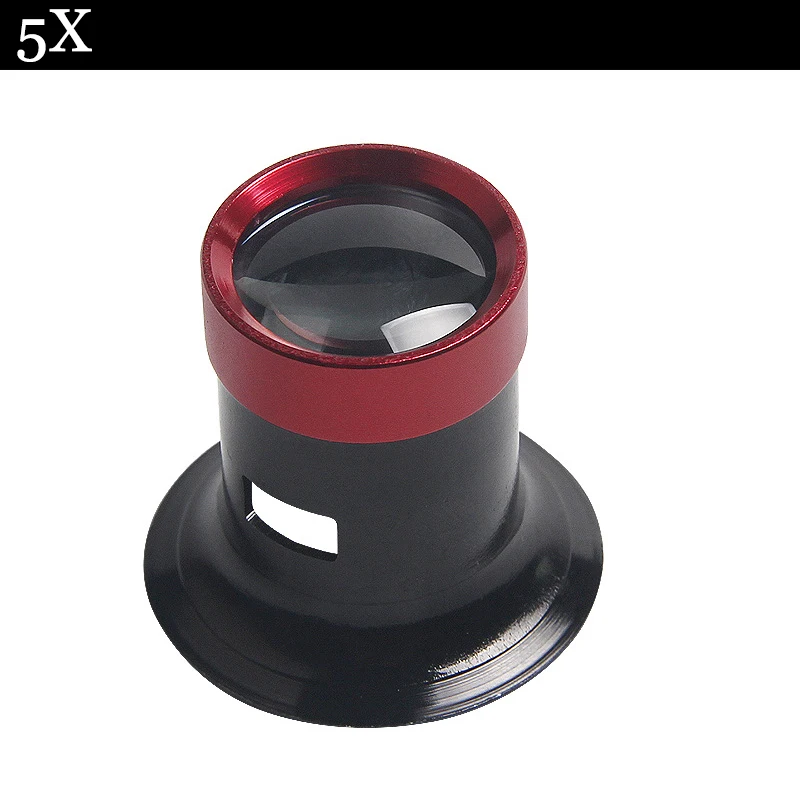
- Loupe or magnifier (3–5×) and a bright desk lamp
- Fine-tip permanent marker
- Small flush cutters, or stem-cutting pliers
- Small flat needle file
- Low-strength thread lockerOptional
What each is for, and where to buy
Case holder
A plastic holder that grips the case by its sides, with a soft pad or cloth under the crystal.
Movement holder
For taking the stem out before casing.
Fine plastic- or brass-tipped tweezers, or a fine screwdriver
To press the stem release.
Nitrile gloves or finger cots
Dust or a fingerprint inside the crystal stays there for good.
Hand air blower (rubber bulb)
For dust inside the crystal and filings from the stem.
Loupe or magnifier (3–5×) and a bright desk lamp
For finding the stem release and checking the crown gap.
Fine-tip permanent marker
For marking where to cut the stem.
Small flush cutters, or stem-cutting pliers
Flush cutters are also sold as side cutters.
Small flat needle file
For filing the cut end of the stem flat.
Low-strength thread lockerOptional
Purple, such as Loctite 222, for the crown.
Steps
The illustrations are AI drawings made to show each step, not photos. They simplify the parts, so where a drawing and the text differ, follow the text.
Step 1: Prepare the case
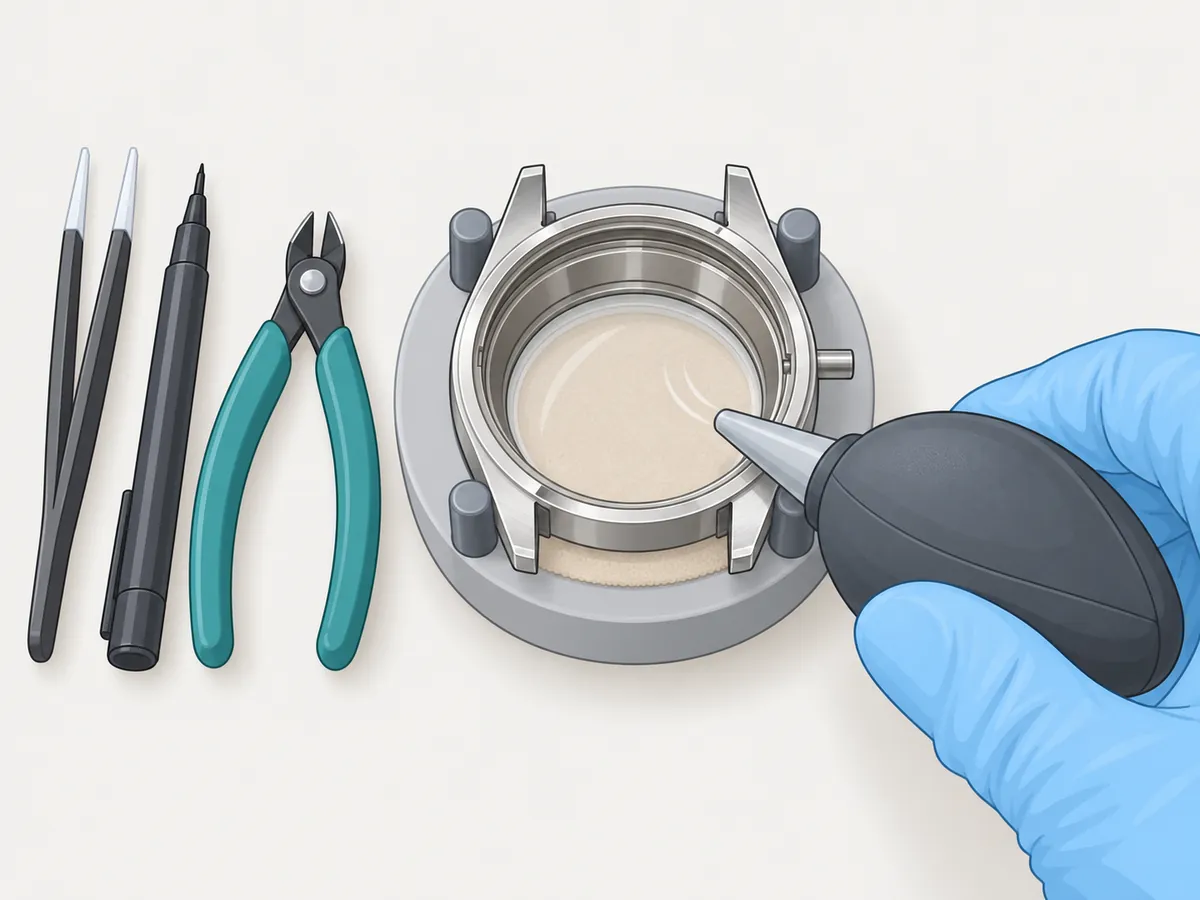
Put on gloves. Put a soft pad or folded cloth in the case holder and lay the case on it crystal-down, with the open back facing up. Turn the case so the crown tube points to your right, then close the holder's pegs onto the sides of the case, between the lugs, until it doesn't move. Never clamp on the crystal or the bezel. Blow out the inside of the crystal: any dust left now is under the crystal for good. If your case has a separate chapter ring, put it in now.
Step 2: Take the stem out of the movement
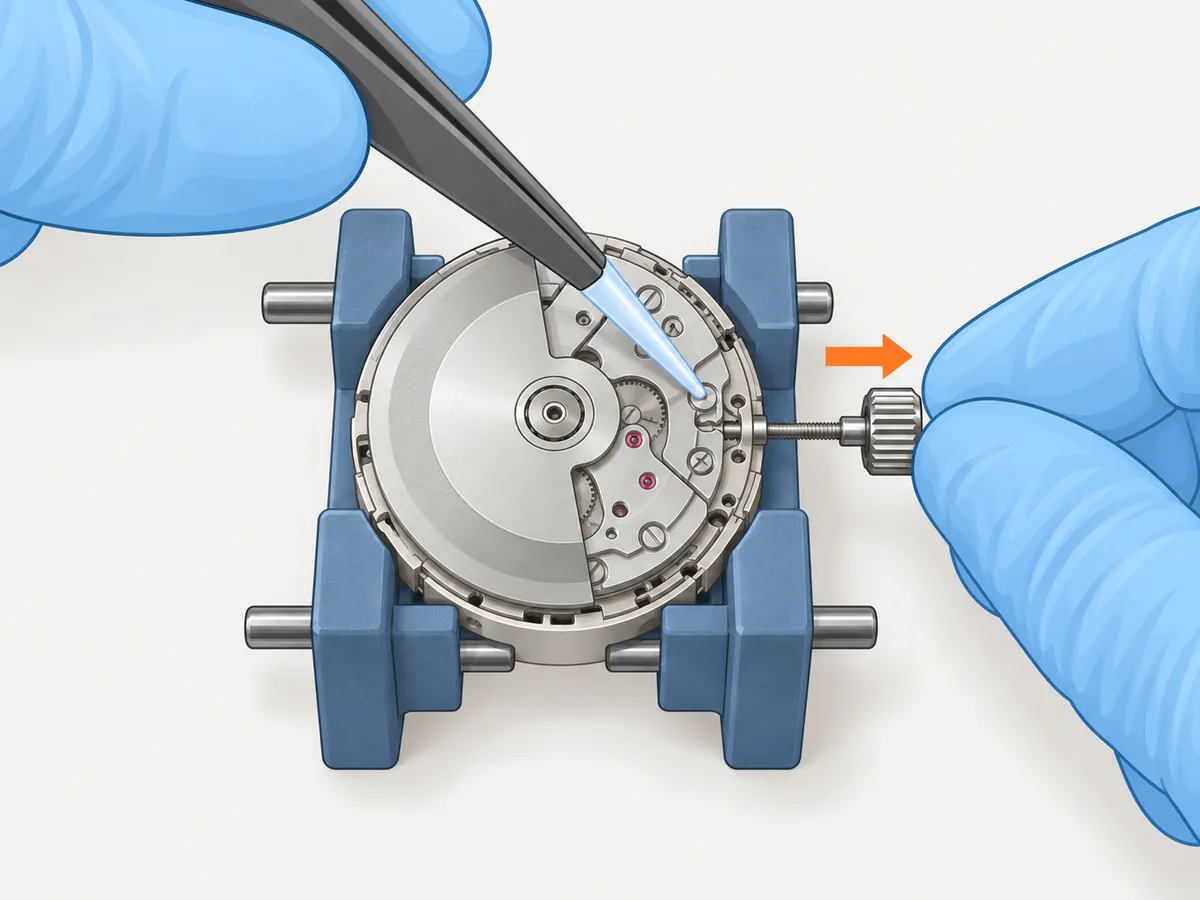
Seat the movement dial-down in the movement holder so you can see the back (the rotor side), with the stem pointing right. Rest it so nothing presses on the hands. Push the crown fully in to its normal winding position (position 0). Seiko's guide says the stem comes out only from this position, and the release point moves away when the crown is pulled out. Find the release point under the loupe. It's a tiny lever end right next to where the stem enters the movement. If the rotor is over it, turn the rotor aside gently by its edge. Press the release straight down lightly with the tweezer tip, and at the same time pull the crown straight out. The stem should slide out with almost no force. If it doesn't, don't press or pull harder. Check that you're on the right spot and that the crown is fully in.
Step 3: Fit the movement ring
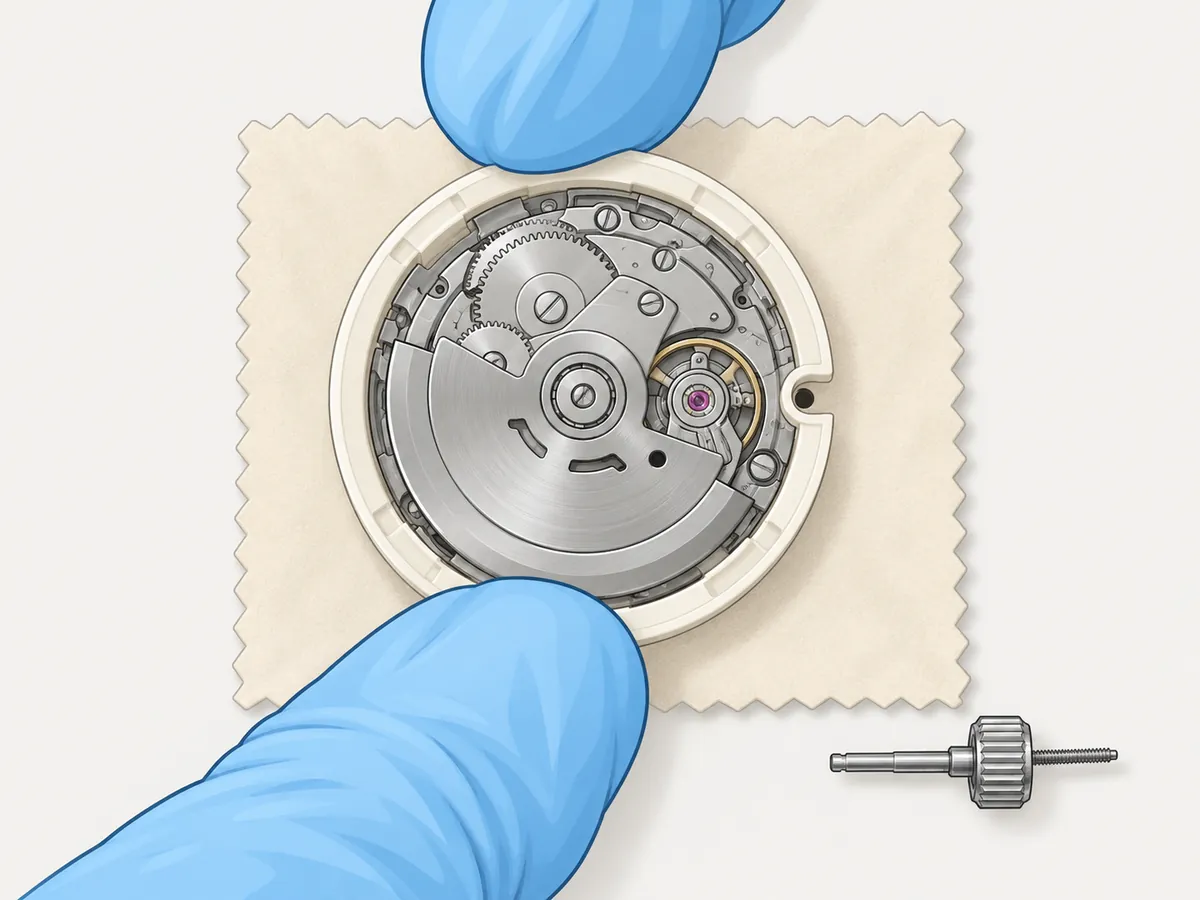
If your case came with a movement ring (a plastic or metal spacer that fills the gap between the movement and the case), fit it around the movement now, while you can still see everything. Turn it so its notch sits over the hole where the stem goes in. It should sit evenly around the movement without tilting it. If it has a step or lip, try it both ways and keep the way it sits flat. Some cases are made to fit the NH35 directly and have no ring: if so, skip this step.
Step 4: Lower the movement into the case
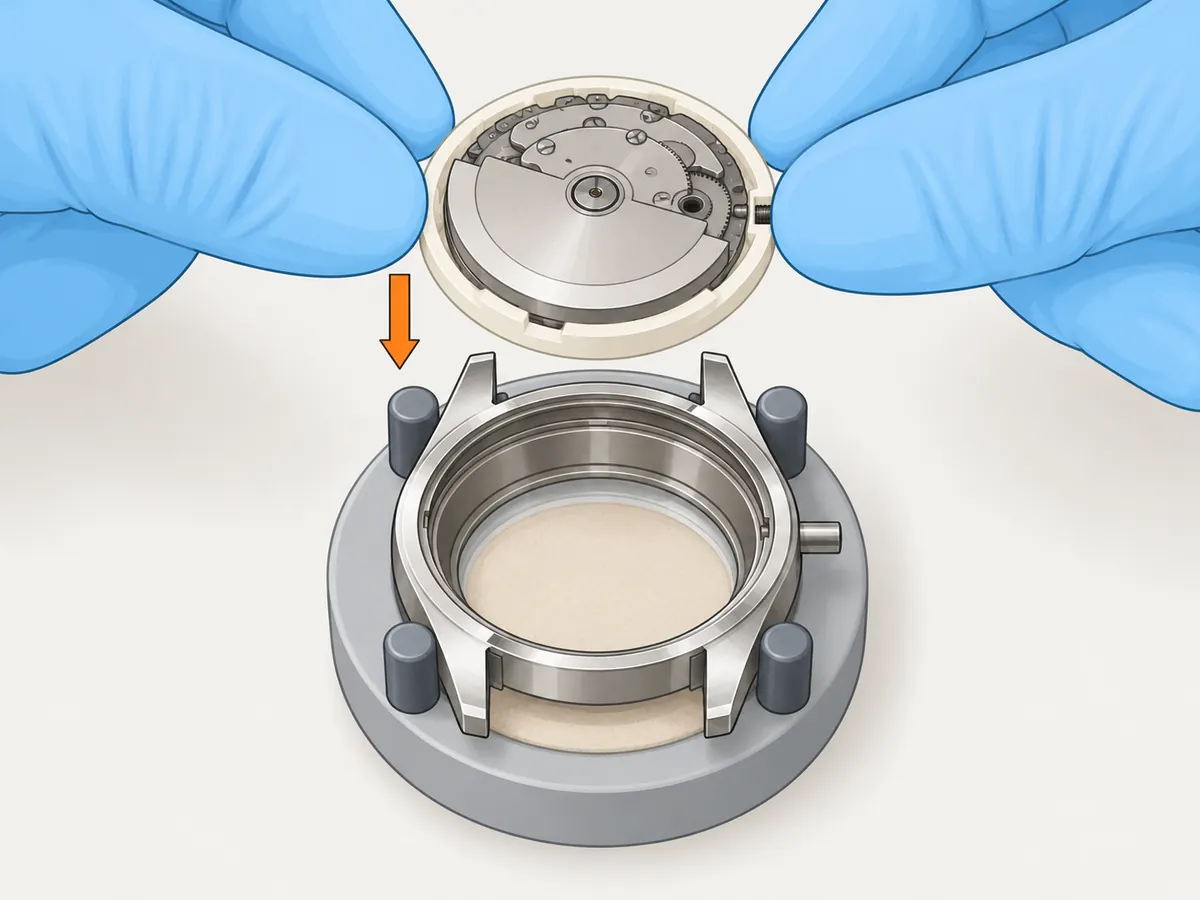
Hold the movement by its edges or by the ring, dial-down, with the stem hole lined up with the crown tube on your right. Lower it straight into the case until it sits flat on its seat. Don't touch the hands, and don't slide it in at an angle, or the hands can catch on the chapter ring or the case edge. Look through the stem hole: you should see straight through to the crown tube.
Step 5: Push the stem back in until it clicks
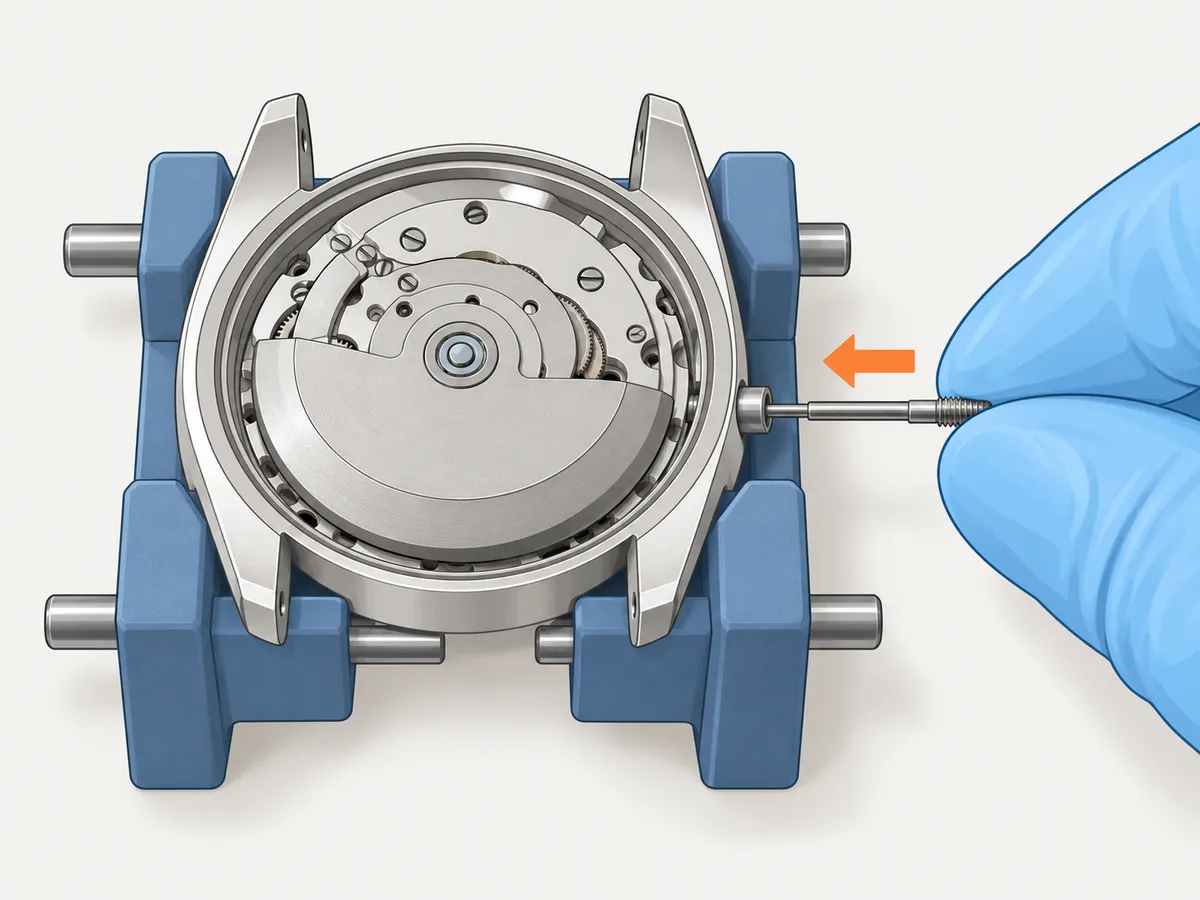
Feed the stem (without the crown) through the crown tube from outside the case, inner end first. Guide it into the stem hole in the movement and push it in gently until you feel and hear it click. If it stops short, turn it a little while pushing lightly so its squared end lines up, or press the release lightly as you push. Don't force it. If it still won't go in, see Common mistakes. Once it clicks, give it a light tug. It should stay in.
Step 6: Check whether the stem needs cutting, and mark it
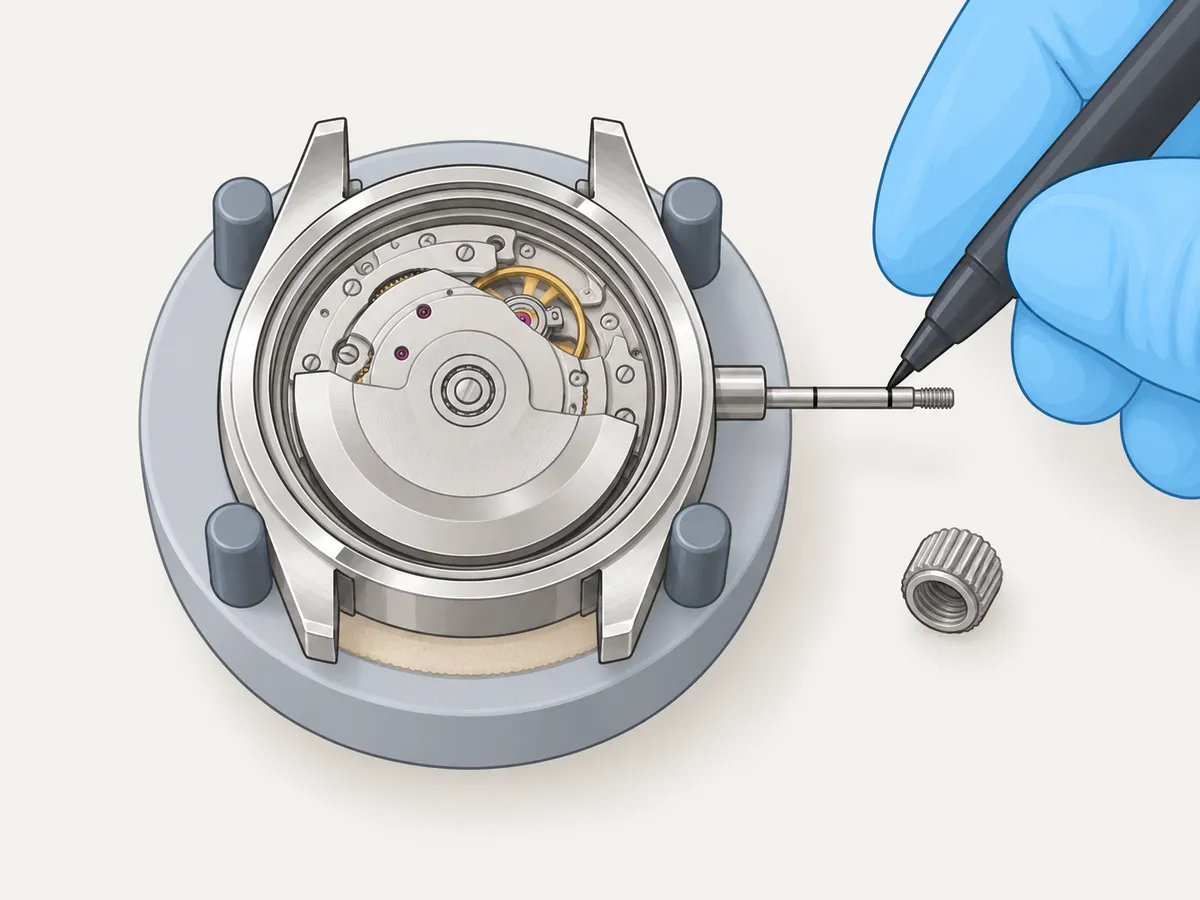
If your case came with a crown and stem cut to fit, skip to step 9 and just check them. Otherwise, with the stem pushed fully in, measure how deep the crown's threaded socket is. Screw the crown onto the end of the stem by hand until it stops, mark the stem at the crown's base with the marker, then unscrew it. The distance from the end of the stem to that mark is the socket depth. Next, mark the stem where it comes out of the end of the crown tube. The stem needs to stick out past the tube by the socket depth plus a little extra, so the crown sits just clear of the case when pushed in. Make your first cut mark about 1 mm further out than that. It's meant to be too long.
Step 7: Take the stem out and cut it off the watch
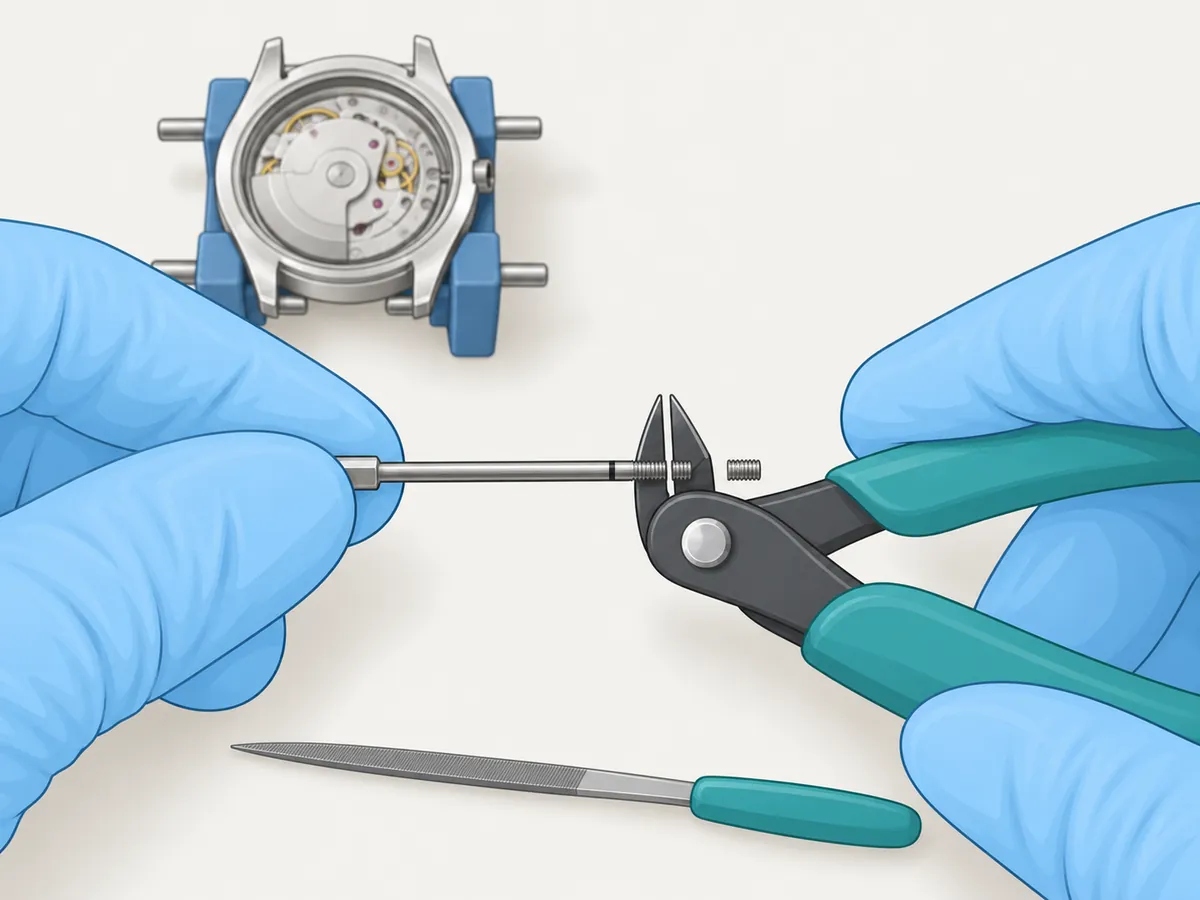
Take the stem out again. From the back of the movement, press the release lightly as in step 2 and pull the stem out through the tube. Never cut the stem while it's in the movement. Cutting puts a sideways load on the keyless works, and metal chips fall into the case. Hold the stem by its inner end and cut at your mark, at the outer, threaded end only. Then file the cut end flat and take the sharp edge off, so the crown's thread starts cleanly. Check that there's still enough thread for the crown to grip. Blow off any filings.
Step 8: Refit the stem and crown, and test the length
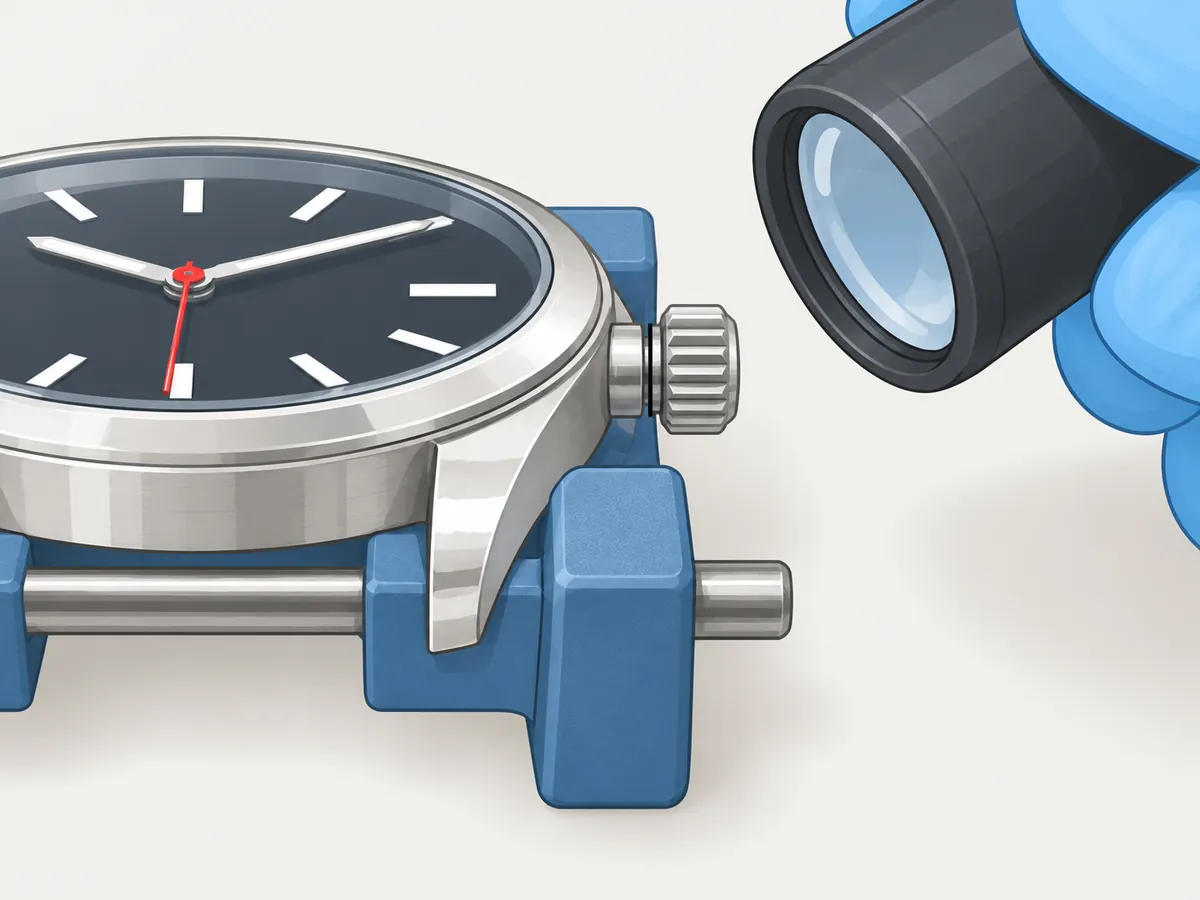
Push the stem back in through the tube until it clicks, as in step 5, and screw the crown on until it stops. Push the crown in and look from the side. On a push-pull crown, the crown should sit just clear of the end of the tube, about the thickness of a sheet of paper. On a screw-down crown it should thread onto the tube and screw down fully without pushing hard. If the crown sits too far out, or won't screw down, take the stem out and trim another 0.5 mm. Then test again. Repeat until it's right. Don't take off more than 0.5 mm at a time.
Step 9: Check the crown positions and that the movement sits still
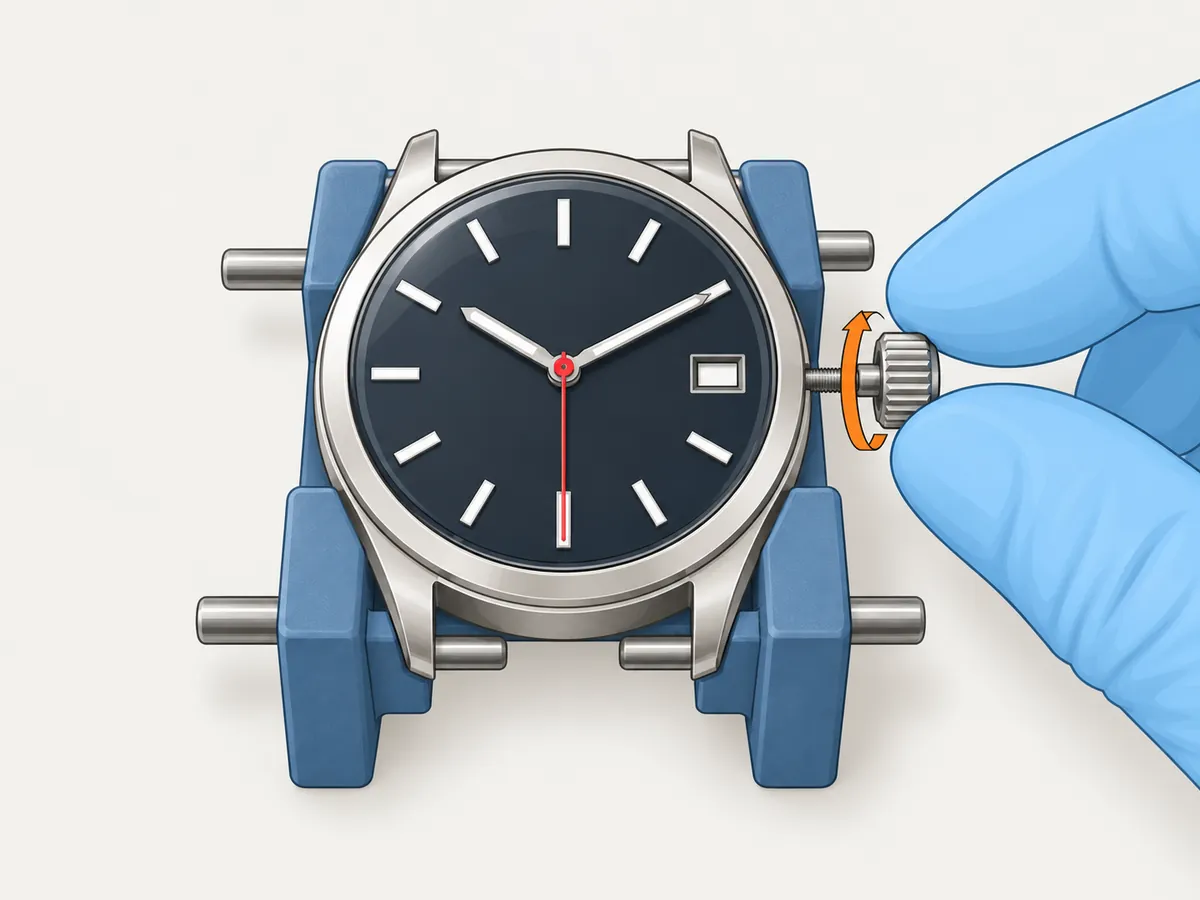
With the crown pushed in (position 0), turn it forward (clockwise) a few times. You should feel it winding, and the seconds hand should start running. Pull it out to the first click (position 1). Turning it changes the date, but leave the date alone between 9 pm and 4 am. Pull it to the second click (position 2). The seconds hand should stop and the hands should turn. Push it back in. On a screw-down crown, push it in gently and turn it clockwise until it stops. Don't force it tight. Then look through the crystal: the movement must sit level and not turn when you wind, and every hand must clear the crystal and chapter ring. When you're happy, you can take the crown off once more and add a tiny drop of thread locker to the stem's thread, keeping it away from the movement. The case is now ready for its caseback.
Common mistakes
Pressing the release with the crown pulled out. Seiko's guide says the stem comes out only from the normal position. With the crown pulled out, the release point isn't where it should be, and pressing harder can knock parts of the keyless works out of place.
Pressing the release too hard or too far. It needs only a light touch. Pressing hard or in the wrong spot can push the setting lever out of place. Then the stem won't lock in, and the fix means taking the movement apart.
Cutting too much at once. A stem cut too short can't be fixed. The crown won't click into its positions, or it will already be in the date position when you unscrew it. Order a spare stem before you case your first watch.
Cutting the stem in the movement. Always take it out first. The sideways force and the chips are both bad for the movement.
Forcing the stem in. If it won't click, something is out of line. A gear on the dial side may have shifted, or the stem may be the wrong one. Stop, take it out and look.
Wrong stem. Stems for other movements (Miyota, ETA) won't lock into an NH35. Buy stems listed for NH35/NH36.
Clamping the case on the crystal. The case holder's pegs go on the sides of the case only.
Dropping the movement in at an angle. The hands can catch on the chapter ring or the case edge. Lower it straight down.
Check before closing the caseback
- The stem clicks firmly into place and doesn't come out with a light tug.
- The crown clicks cleanly through all three positions: 0 (wind), 1 (date), 2 (time). The seconds hand stops at position 2.
- On a screw-down crown, it screws down fully by hand and pops out when you unscrew it.
- The movement sits level and doesn't turn in the case when you wind it.
- Look side-on through the crystal: every hand clears the crystal and the chapter ring.
- No dust, fibres or filings on the dial or inside the crystal.
Plan a watch around an NH35
Pick a case, dial, hands and strap for the movement, see which parts likely won't fit and preview the finished watch before you buy anything.
Sources
- Seiko Instruments (SII) / Time Module, Technical Guide & Parts Catalogue, Cal. NH3 series. "To remove the winding stem: set the winding stem to normal position; pull out the winding stem while pushing 'A'." Crown positions, winding direction, date-setting window. Hosted by Cousins UK.
- Seiko Instruments (SII), Cal. NH3 series parts sheet / technical guide v02. Hosted by Cousins UK.
- Horologic, How to remove the crown stem from an NH35 movement. Release beside the stem opening, crown fully in, light press, pull straight, stop rather than force.
- WatchRepairTalk, NH35 stem issues. Stem removal only in the winding position; a stem cut too short; a displaced dial-side gear.
- WatchRepairTalk, Stem insertion into NH36. Pressing the release while inserting; a displaced yoke as the cause of a stem that won't lock.
- WatchRepairTalk, Seiko stem release lever. How the push lever lifts the setting lever (Seiko 5606).
- WatchRepairTalk, Help with shortening a stem for a screw-down crown. Mark, cut long, file and try; measure from the tube end to the bottom of the crown.
- WatchRepairTalk, Stem length on screw-down crown, Seiko NH35. Symptoms of a stem cut too short; trimming a fraction of a millimetre at a time.
- WatchRepairTalk, Stem crown Loctite. Purple 222 vs blue 243 vs none.
- WatchRepairTalk, How to attach crown to stem
- NoMods, How to build your first Seiko mod. Stem supplied too long, trim 0.5 mm at a time, a short stem can't be fixed.
- Lucius Atelier, Seiko Modding: The Complete Build Guide. The movement goes in from the case-back side; "you can always shorten further; you can't lengthen".
- Lucius Atelier, Seiko TMI NH35 movement product page. Ships with a full-length threaded stem and a dummy stem.
- DIY Watch Club, Diver kit instructions. Movement holder fitted to the movement before it goes into the case.
- ModMode, Grey movement spacer ring for NH movements
- Rotate Watches, Seiko mod parts compatibility. Spacer rings differ between 7S26 and NH35 heights.
- Esslinger, How to open a screw-down case back with a Jaxa wrench. Grip the case in a holder so it can't move.