How to fit the hands on an NH35 movement
The hands are the last parts to go on before the movement is cased, and they are the step where most first builds go wrong. On a Seiko NH35 (and the day-date NH36) you fit three hands in a fixed order: hour, then minute, then seconds. Each one is pressed straight down onto its post with a hand press. Before any hand goes on, you find the point where the date changes and fit the hour and minute hands both pointing at 12 there, so the date flips at midnight instead of mid-afternoon. Go slowly, press gently, and check every hand from the side before you fit the next one.
- Time
- 20–40 minFor a first build. Most of it is checking.
- Difficulty
- ModerateIt's not complicated, but it takes a steady hand and patience. The seconds hand is the fiddly part.
- Works with
- NH35
- NH36
What you need
Parts
NH35 or NH36 movement
With the dial already fitted, and the stem and crown (or a spare stem) installed.
One set of NH35-fit hands
Hour, minute and seconds. Listings normally give the hole sizes as about 1.50 mm (hour), 0.90 mm (minute) and 0.20–0.21 mm (seconds). The same hands fit the NH34, NH36 and NH38. ETA 2824/2836 hands are not a match: their seconds hole is larger (0.25 mm), so the seconds hand will sit loose.
Tools
Movement holder sized for the NH35
A plastic holder with a slot for the stem. It supports the movement from underneath while you press.
Hand press
A pen-style press with nylon tips is fine. You need a tip with a small hole for the hour and minute hands, and a flat tip for the seconds hand.
Plastic- or brass-tipped tweezers, or Rodico
To pick up and place the hands. Rodico is watchmaker's putty; a small piece is enough.
Nitrile gloves or finger cots
Skin oil leaves marks on a dial that you can't wipe off.
Hand air blower (rubber bulb)
Don't use canned air: it can spray cold propellant onto the dial.
Loupe or magnifier (3–5×) and a bright desk lamp
For checking each hand from the side.
Hand-removal levers and a dial protectorOptional
For refitting a hand. The protector is a thin plastic sheet with a slot that slides under the hands.
Steps
The illustrations are AI drawings made to show each step, not photos. They simplify the parts, so where a drawing and the text differ, follow the text.
Step 1: Set up a clean, bright workspace
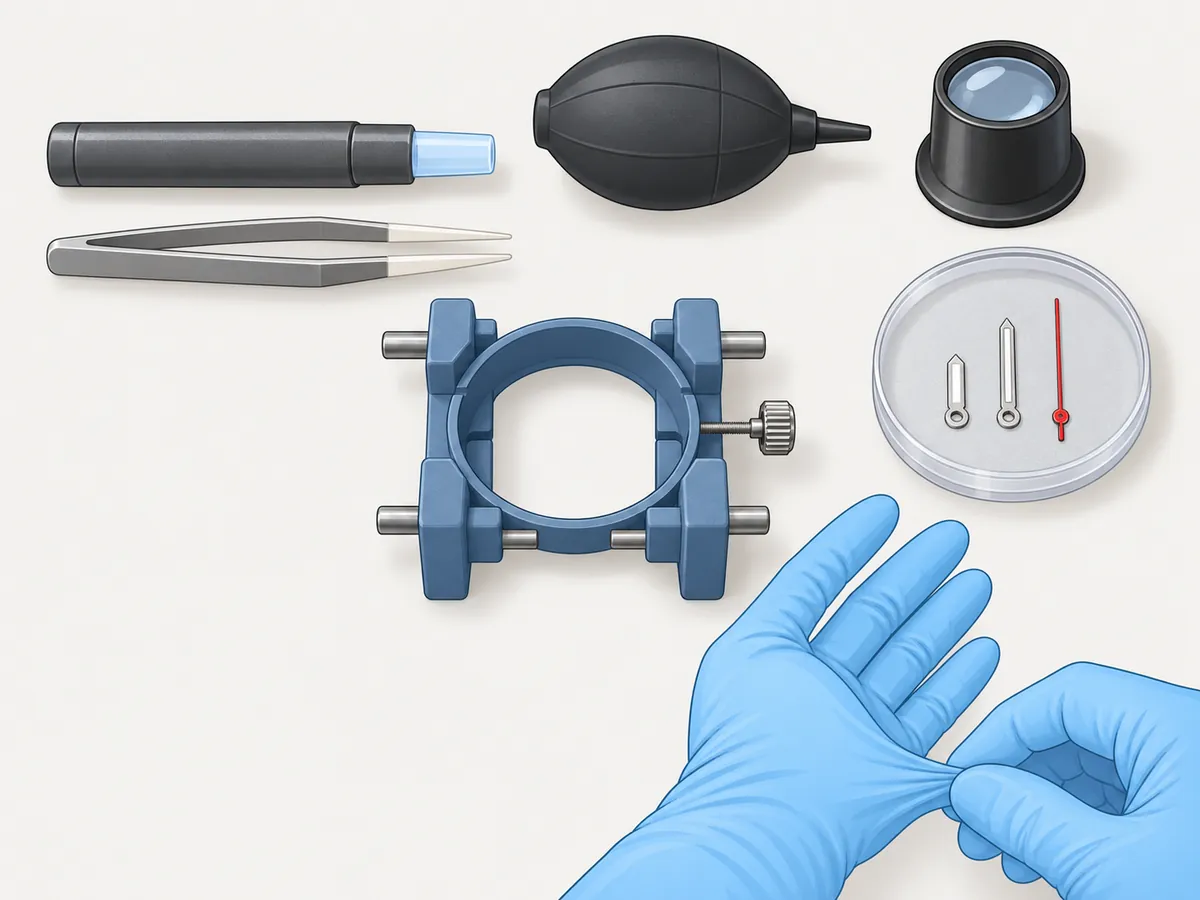
Work on a clean, light-coloured mat under a bright lamp, and put on gloves or finger cots. Skin oil leaves marks on a dial that you can't wipe off, so never touch the dial, the hands or the posts with bare fingers.
Step 2: Put the movement in the holder, dial up
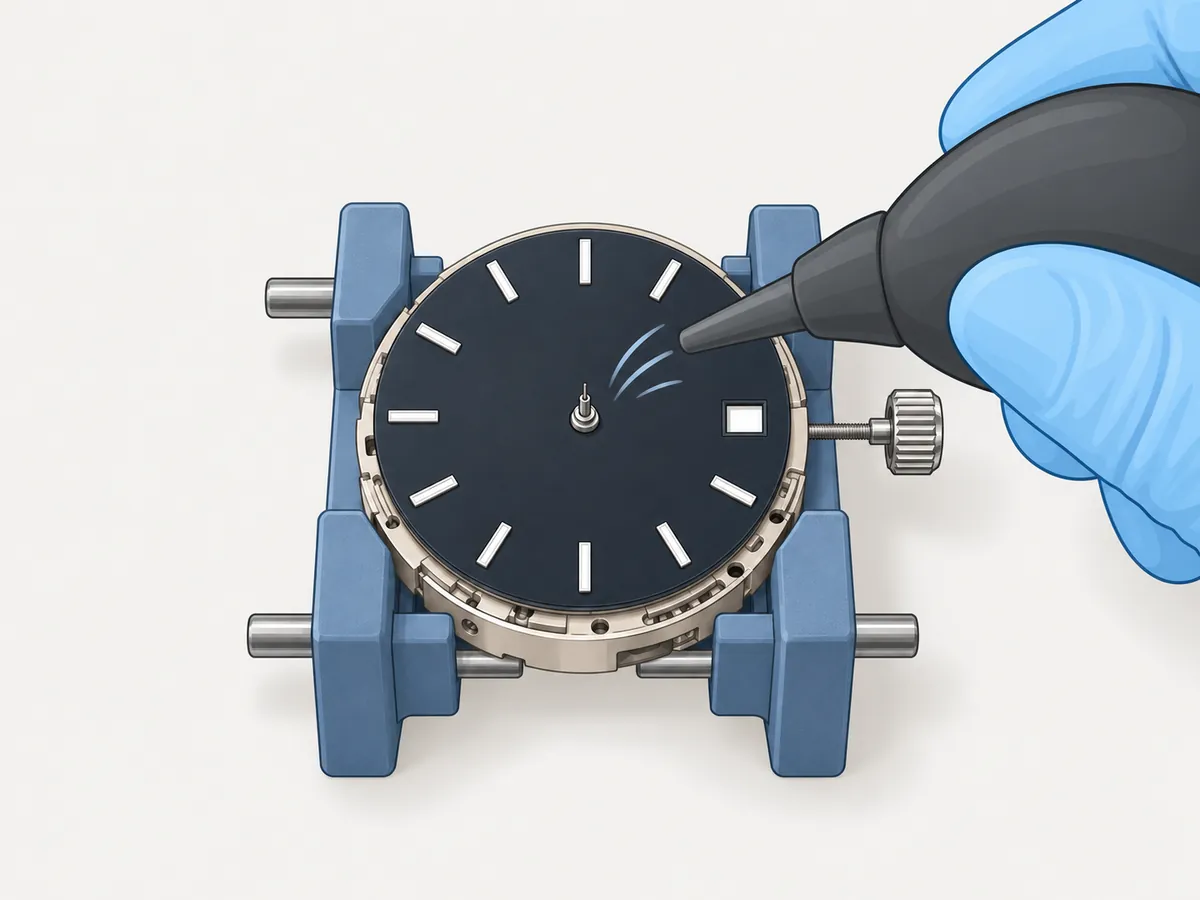
Seat the movement dial-up in the holder, with the stem lying in the holder's slot. Check that the movement sits level and doesn't rock. Seiko's guide says to support the movement on a flat, firm base while fitting hands, so put the holder on the desk, not in your hand. Peel off any protective film on the dial and blow away any dust.
Step 3: Pull the crown out to the second click
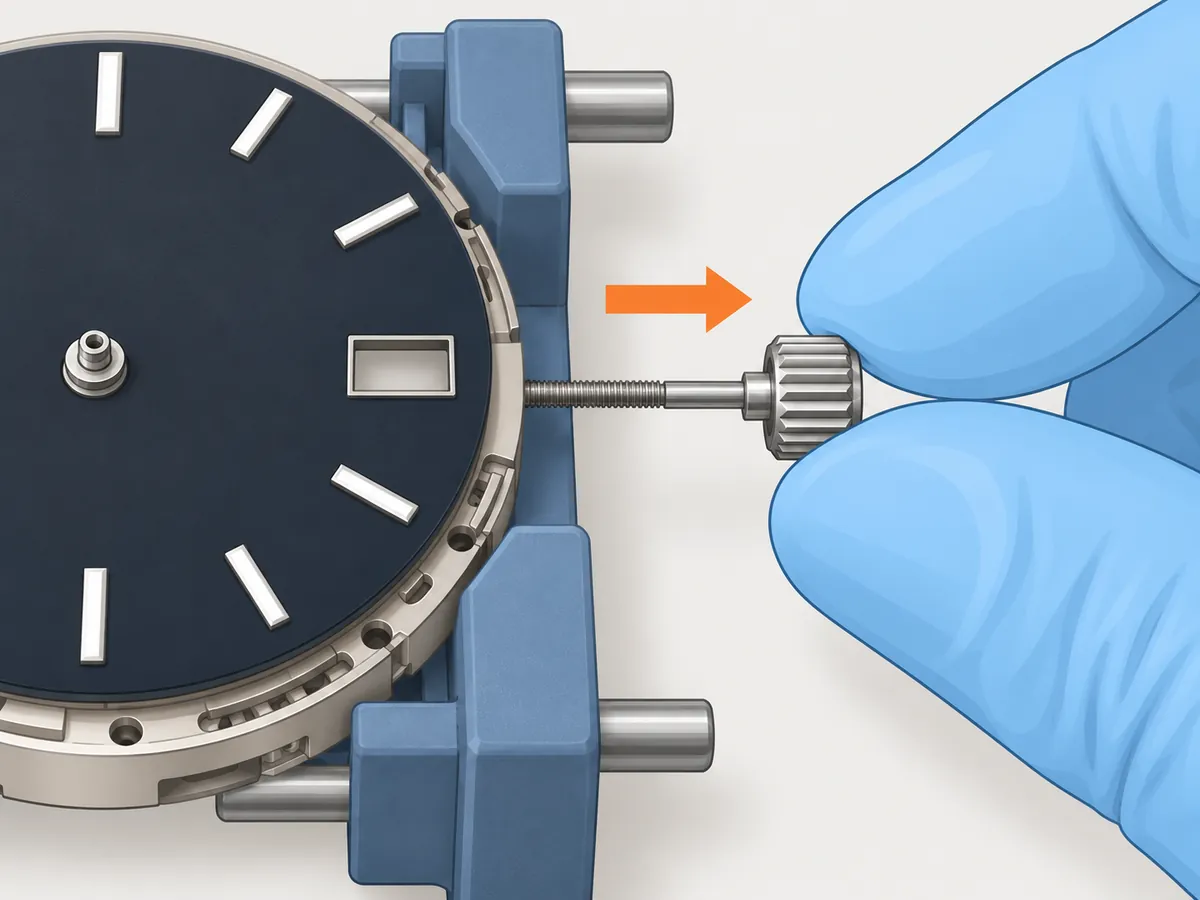
Pull the crown out two clicks to the time-setting position. This stops the movement (it "hacks"), so the seconds post isn't turning while you work, and it lets you move the hand gears with the crown. Leave it there until the last check.
Step 4: Find the moment the date changes
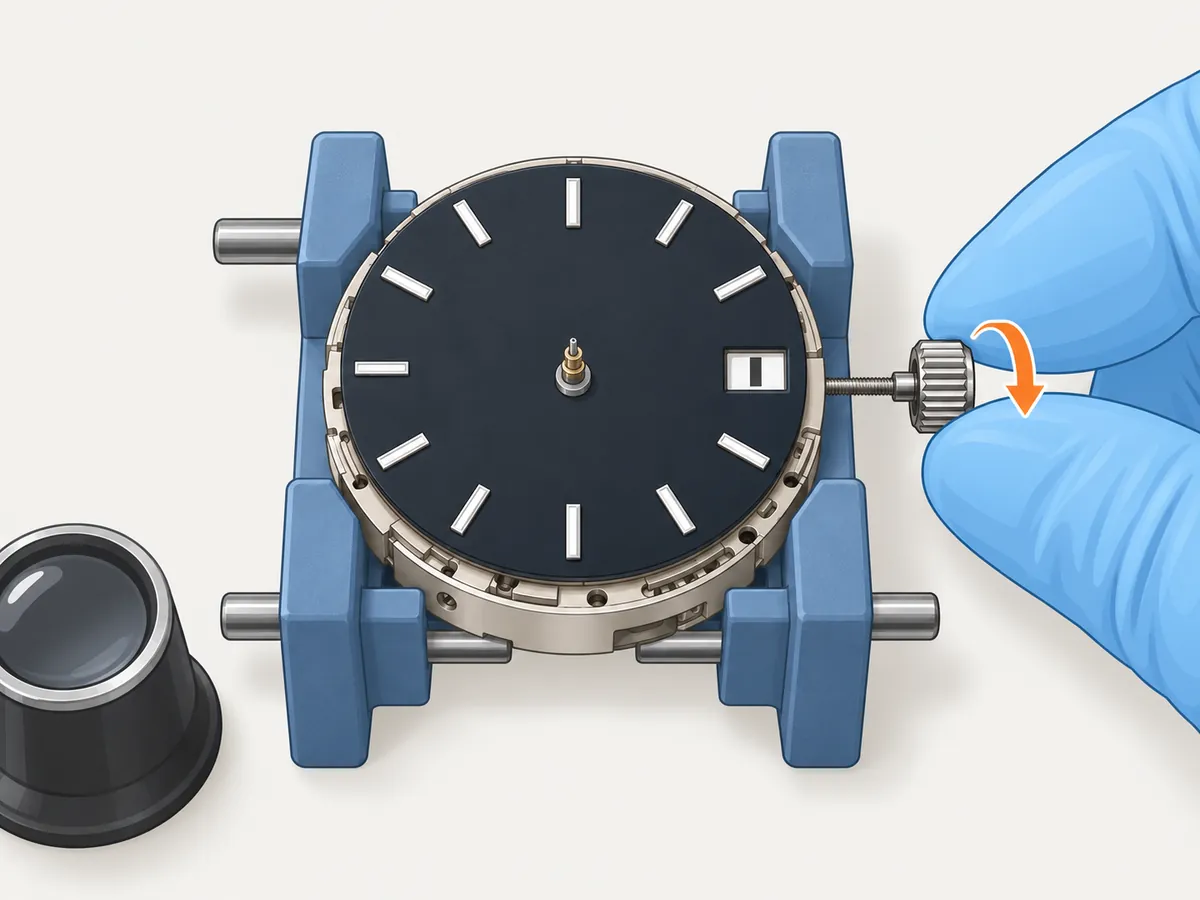
With no hands fitted yet, turn the crown slowly and watch the date in its window. Stop as soon as the new number has fully moved into place. In this position, 12 o'clock is midnight. Fitting the hands here makes the date change at midnight, and keeps the 9 pm to 4 am "don't quick-set the date" window where Seiko says it should be.
Step 5: Fit the hour hand pointing at 12
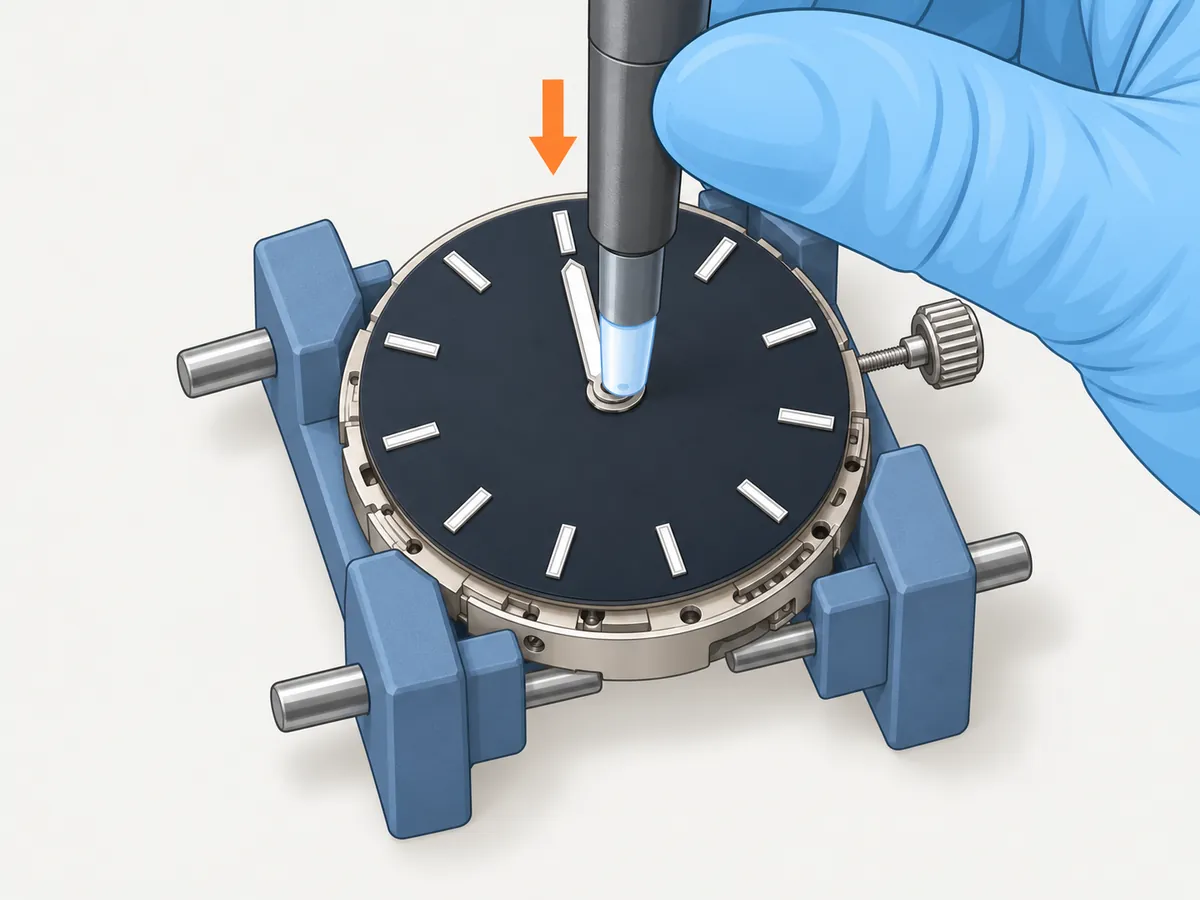
Blow the hour post clean. Then pick up the hour hand (the shortest, widest hand) and lower it flat onto the post, pointing exactly at 12. Use the press tip with a hole: it pushes on the hand's raised collar and leaves the post itself alone. Press straight down with steady, light force until the hand stops moving. Don't tap or hammer. Look from the side to check that it sits parallel to the dial, clear of the dial and the date window.
Step 6: Fit the minute hand pointing at 12
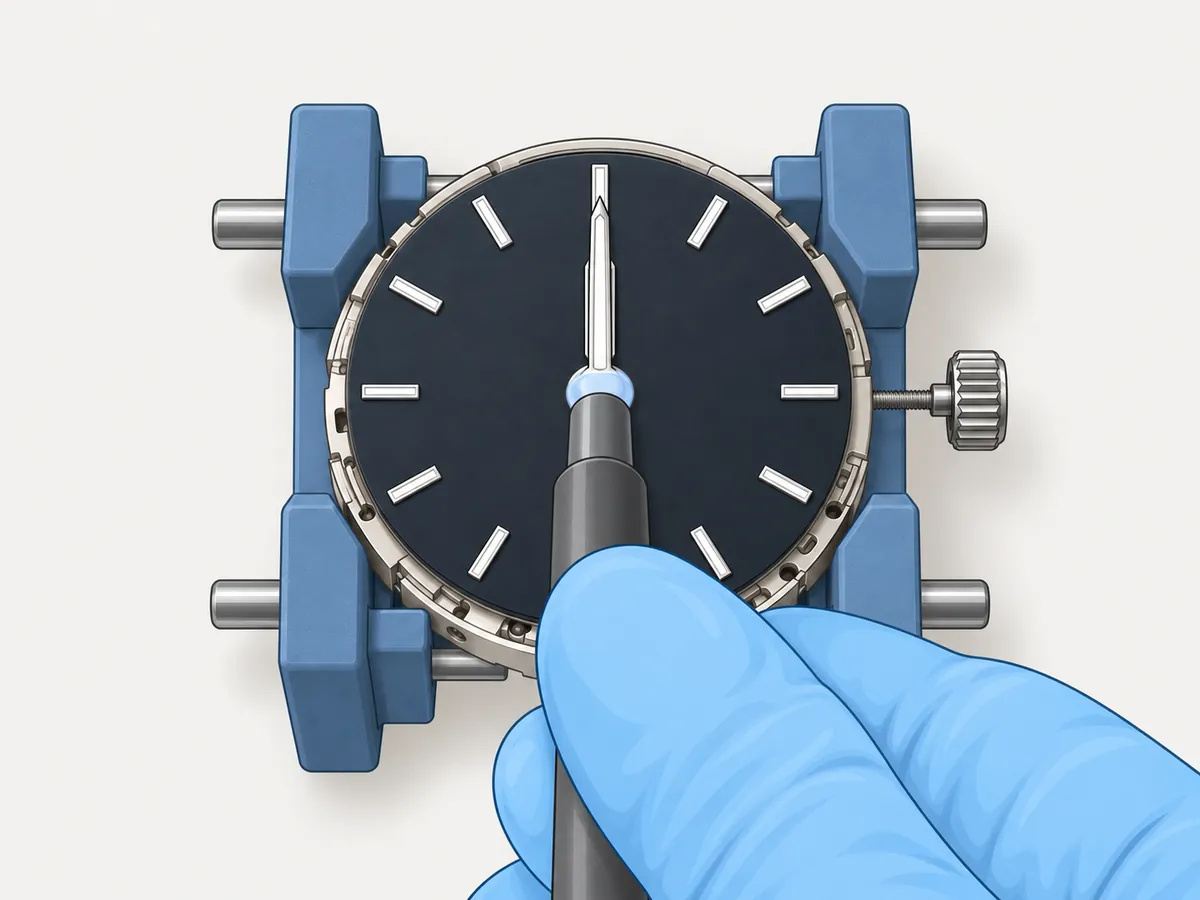
Without turning the crown, lower the minute hand onto the thinner post above the hour hand, also pointing exactly at 12, so it sits directly over the hour hand. Press straight down with the holed tip until it stops. From the side you should see a small, even gap between the minute hand and the hour hand along their whole length.
Step 7: Turn the hands through a full day and check
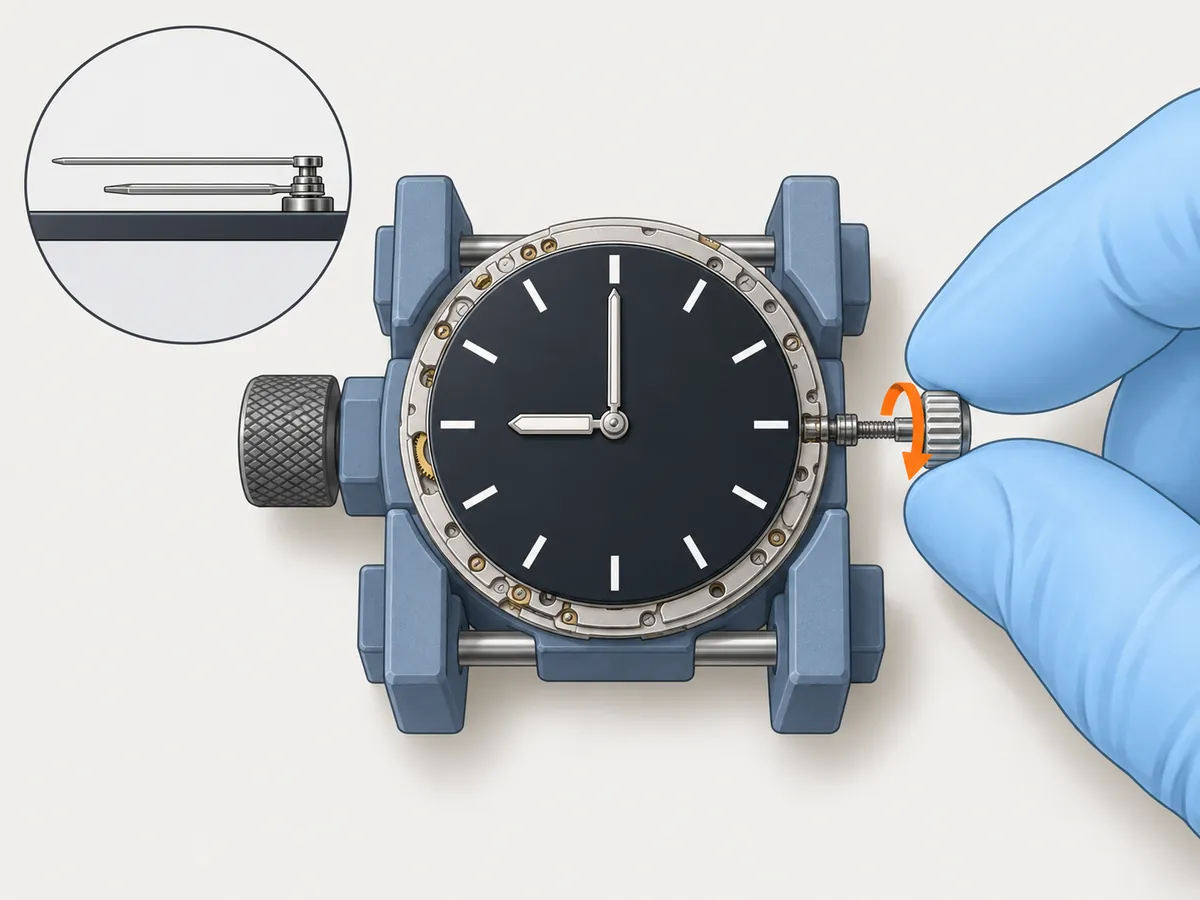
Turn the crown slowly forward for a full 24 hours. At every hour, the minute hand should be on 12 when the hour hand is on an hour marker. Watch where the two hands cross: they must never touch, and neither may touch the dial. The date should change as both hands reach 12 again. If something is off, take the hand off with a hand lever and dial protector and refit it. Don't bend a hand to make it fit.
Step 8: Fit the seconds hand last
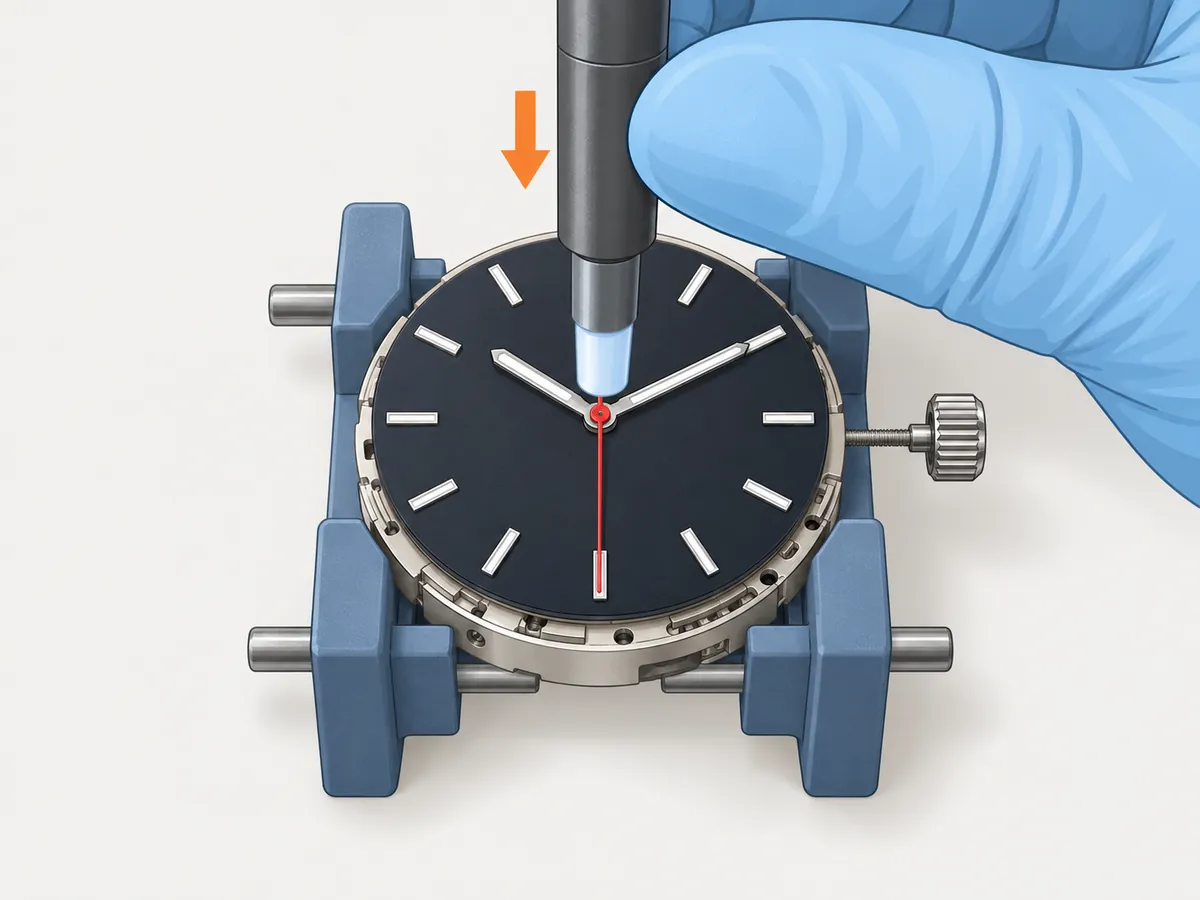
Turn the crown to about 10:10, so neither hand is near 6. Lower the seconds hand (the longest, thinnest hand) onto the very fine centre post, pointing at 6, and press it on with the flat tip. Use the lightest pressure that seats it. If it doesn't go on easily, lift it off and line it up again. Pushing harder can bend the post or knock its jewel out of place.
Step 9: Let it run and check from the side
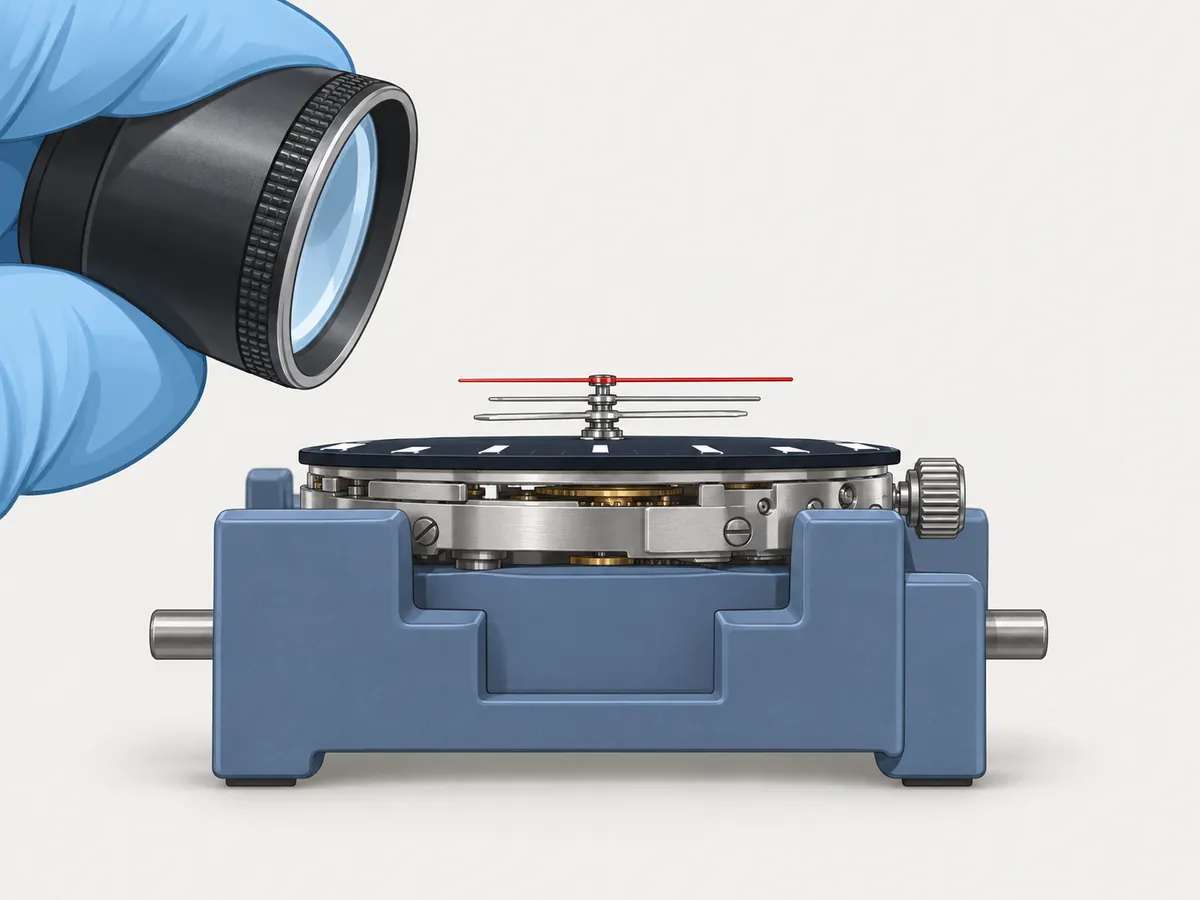
Push the crown back in (position 0) and give it a few turns, or gently tilt the movement, so it starts running. Watch the seconds hand make a full turn. Then look from the side at 12, 3, 6 and 9: all three hands should be level, evenly spaced, and clear of the dial, the indices and each other.
Common mistakes
Fitting the hands at a random time. If you skip step 4, the date changes at noon or in the middle of the afternoon. You then have to pull the hour and minute hands off and refit them.
Hour and minute hands not lined up at 12. When the minute hand is on 12, the hour hand sits between two markers. Fit both hands without turning the crown in between.
Pressing too hard, or tapping. Too much force bends hands, crushes the hour hand into the dial, or damages the delicate seconds post and its jewel. Seiko's guide asks for a steady press and warns that shocks can damage the movement.
Using the wrong press tip. A flat tip on the hour or minute hand can flatten the hand's collar or press on the post itself. Use a tip with a hole for those two, and a flat tip only for the seconds hand.
Tilted hands. A hand that isn't parallel to the dial will catch on a marker, the date window edge or the next hand, often only at one position on the dial. Check from the side every time.
Hands touching. If the seconds hand rubs the minute hand, the seconds hand stops, or both hands get dragged along together. Reseat the hand so the gap is even. Don't force it down further.
Bending hands to fix fit. If a hand needs bending, it's usually seated crooked or it's the wrong size. Take it off and check it.
Wrong hands. Hands sold for ETA or Miyota movements may have a different seconds hole. Look for "fits NH35" with hole sizes listed.
Bare fingers and dust. One fingerprint or speck of lint under the crystal is visible forever. Wear gloves and blow everything clean before each hand.
Check before closing the case
- Advance the time through 24 hours at least once more. The date should change only when both hands are at 12, and it should sit centred in the window.
- Hands are parallel to the dial and evenly spaced. Nothing touches anywhere around the dial.
- The seconds hand runs smoothly with the crown pushed in, and stops when you pull it to the second click.
- The crown clicks cleanly through all three positions: 0 (wind), 1 (date), 2 (time).
- After the movement goes in the case, look side-on through the crystal. The seconds hand must clear the crystal, and on cases with a chapter ring it must clear the ring as well. If a long seconds hand tip is very close, check whether a thinner dial spacer or a different hand is the right fix.
- Look at the dial under the loupe one last time for dust or fingerprints before you close the case back.
Plan a watch around an NH35
Pick a case, dial, hands and strap for the movement, see which parts likely won't fit and preview the finished watch before you buy anything.
Sources
- Seiko Instruments (SII), Technical Guide, Cal. NH34A/35A/36A/37A/38A/39A. Hand attachment, crown positions, date-setting window. Hosted by Cousins UK.
- Seiko Instruments (SII), Cal. NH3 series parts sheet / technical guide v02. Hosted by Cousins UK.
- Time Module (SII's movement brand), NH37 technical guide
- Lucius Atelier, Tutorial: how to modify your Seiko watch dial and hands
- Lucius Atelier, Seiko Modding: The Complete Build Guide
- Watch-Modz, Learn how to mod – tutorials
- NoMods, How to build your first Seiko mod
- The Watcher HQ, How to build a Seiko mod
- Rotate Watches, NH36 day-date setting danger zone
- Rotate Watches, Seiko mod parts compatibility
- DIY Watch Club forum, Second hand moves with minute hand
- DIY Watch Club, NH35 movement product page. Hand sizes H 1.5 / M 0.88 / S 0.2.
- WatchRepairTalk, Installing 2836 hands on NH35. NH35 1.50 / 0.90 / 0.21 vs 2836 0.25 seconds.
- WatchRepairTalk, How do I support sweep seconds pinion to fit hand